
Politics. Half-finished data. Competing agendas. You’re no doubt aware of how messy annual planning can be. But this has dialled up to 11 in 2026 as senior marketers face higher pressure, bigger stakes, and even less margin for error.
Why? There are three key reasons:
- AI is changing the shape of teams and the pace of work.
- CFOs are scrutinising spend more than ever.
- Buyers are harder to see, and making decisions in places you can’t always track.
Let’s consider each one and what it means for your planning in 2026.
1. AI: information at the cost of inspiration
AI isn’t writing your strategy, but it’s rewriting the context you’re planning in. Research, content drafts, basic analyses – all faster and cheaper than ever. That’s good for efficiency, but it also levels the playing field. If everyone can automate the basics, differentiation has to come from somewhere else.
That somewhere else is judgment: which markets to prioritise, where to invest, how to balance pipeline now with growth later, and so on. AI can speed up the groundwork, but your plan must reflect big calls from the higher ups.
Let AI handle the grunt work. Free up your team’s time for decisions that actually win budget and shift markets.
2. CFOs: proving that marketing makes money
Chief Financial Officers have always cared about the numbers in front of them. But between economic uncertainty and the perception of marketing as a cost centre, it can be difficult to… well, market the activity to CFOs.
What does that mean for planning? It means you need to prove marketing’s financial viability with numbers that show marketing is an investment, not an indulgence. Think less “We delivered X impressions” and more “We created demand, protected margin, and reduced churn.”
Create a plan that goes beyond outlining marketing’s activity, making the financial case for why the business investing in marketing is a no-brainer.
3. Buyers: harder to see, not harder to predict
There’s a cliché stat in B2B that “95% of buyers are out of market at any given time.” Is it true? Not really. It depends on your sector, your product, your deal cycles. But the point behind it stands: you can’t expect full visibility of your buyers at all times.
The real shift in 2026 isn’t that buyers are jumping in and out of market faster. It’s that they’re doing more of the journey in places you can’t track. They’re researching quietly, self-serving in channels outside your stack, and leaning on peers and communities rather than filling in forms. By the time they show up in your pipeline, most of the decision is already made.
That makes plans built only around “capturing demand” brittle. The stronger play is to accept the blind spots and measure what you know. Some plays will deliver clean attribution. Others won’t. Both still matter.
Build a marketing mix with metrics that reflect reality – not just what’s easiest to measure.
Avoiding “plandemonium”
While we’ve just covered the biggest factors shaping annual planning, here’s one more: most annual plans collapse under their own weight. 60+ slide decks. Vanity metrics. Activities divorced from outcomes.
That won’t fly in 2026. Plans must be short enough to present in under an hour, clear enough that sales, finance, and product can all get it, and flexible enough to adapt when priorities inevitably change.
If your plan can’t still guide decisions by March, it’s not a plan. It’s theatre.
So, what’s the plan?
AI isn’t slowing down. CFOs aren’t easing off. Buyers aren’t getting easier to track. None of that is going to change, but you can use planning to turn all that pressure into opportunity.
It’s your organisation’s golden ticket to cut through the noise, create coherence from chaos, and prove that marketing isn’t just busywork — it’s driving the business forward.
Annual planning in 2026 isn’t just about predicting the future. It’s about proving you deserve one.
Make your plan count
At tmp, we’ve worked with leading enterprise tech brands to build plans that don’t just survive planning season – they secure investment, win credibility, and deliver growth.
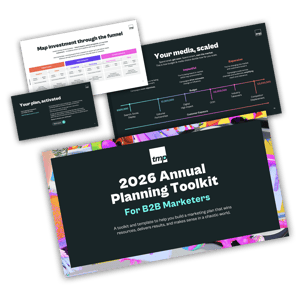
That’s why we created our Annual Planning Better Practice 2026 toolkit. It’s designed to help senior marketers build plans that hold up under pressure, providing a clear framework, a financial lens, and a practical template that shows what good really looks like.