
There was a time when chaos felt like a passing storm. Something you could wait out. Not anymore – the weather has changed. The storm didn’t pass. It settled in and became the new business as usual. Now markets move without warning. Internal structures bend under pressure. And technology moves so quickly that it outruns the people meant to use it.
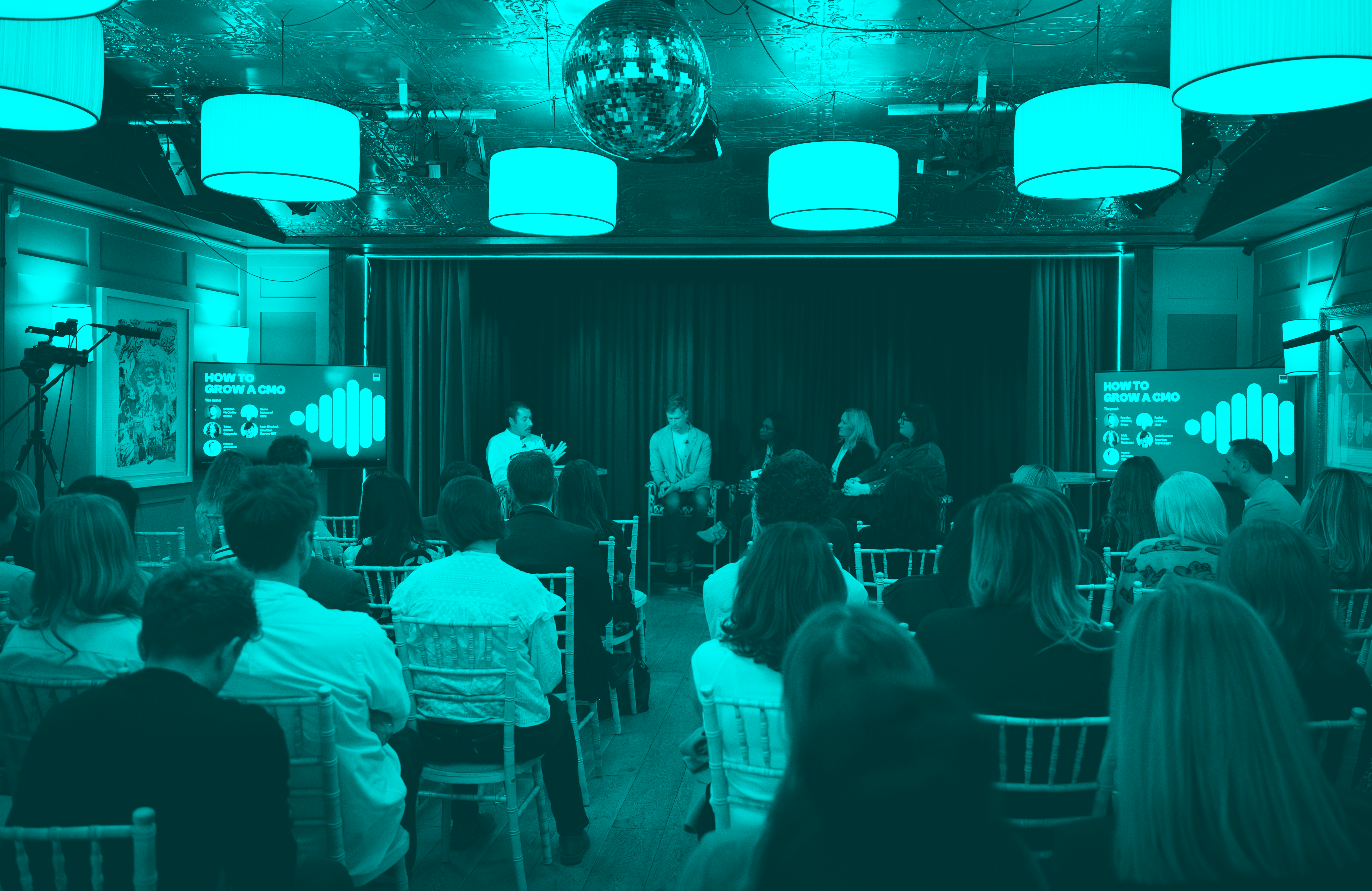
The question facing marketing leaders is not how to avoid turbulence, but how to adjust to it. Across nine conversations in Season 5 of our ‘How to Grow a CMO’ series, we learned that the most effective marketing leaders are the ones who have learned to navigate their way through challenges.
They focus on what matters most and bring humanity back into systems that were growing too mechanical. In doing so, they demonstrate what effective marketing leadership looks like.
Simplicity is a leadership skill
Several of our guests admitted they had once over-indexed on attribution and precision. Many now feel that an obsession with measurability has come at the cost of clarity. After all, customers do not buy complexity – they buy stories they can understand.
Simplicity is not the same as dumbing down. Leaders like Twilio’s Chris Koehler and Criteo’s Brendan McCarthy showed how clarity accelerates alignment: if your strategy and narrative aren’t clear, don’t expect people to go along with them.
In chaotic times, simplicity is a superpower. It aligns teams. It accelerates action. It creates confidence where uncertainty is the default.
“I thought for a long time you could measure everything…
but the reality is you can’t.”
Chris Koehler, CMO Twilio
Brand is back as a stabilising force
For too long in the B2B sector, investing in your brand was regarded as a luxury or dismissed as frivolous. That era is ending. The CMOs we interviewed were clear that brand has become a strategic lever again.
Chris Koehler told us he had to rebuild Twilio’s narrative to reflect the full breadth of the business. Not as a campaign, but as a structural device to align product, sales and marketing around a shared promise. Anna Griffin reframed Commvault around cyber resilience and board-level consequences. Jean Lawrence at Nokia explained that she had encouraged her teams to look out for anything that required a “decoder ring” to understand.
Brand gives organisations something to hold onto when markets shift, buyers stall, and technology pulls focus. It is not a creative exercise. It is a leadership tool.
“Every decision is made emotionally before it is made rationally.”
Anna Griffin, CMO Commvault
The CMO is the nexus
The modern CMO sits in the tension between product, sales, customer success, HR and finance. The job is no longer about running a function. It is about connecting functions that have drifted apart.
Every leader we spoke to made the same point. Silos slow organisations down and distort the story customers hear. The CMOs making progress are the ones who pull teams back into alignment and fix the gaps that no one else owns.
Some talked about reorganising their go-to-market structure to serve the customer better. Others described the CMO as the connective tissue of the business, aligning product, sales and customer success around a single narrative. What matters is not the specific design, but the intent: clarity over confusion, unity over fragmentation.
The reason the CMO has become the integrator is simple. No other role sees as much of the organisation or cares as deeply about how it shows up to customers. Integration is no longer an operating preference. This is a strategic act.
“If you can’t explain the strategy simply, no one will follow you.”
Brendan McCarthy, CMO Criteo
AI: from experimental to operational
AI is no longer speculative. Its potential has been accepted. The work now is operational. A gap is opening up between those who lean in and those who wait. The strongest performers in our series treat AI as a capability shift, not as a set of tools.
Chris Koehler described it as the defining advantage of the decade. Caroline Burger saw it as a way to accelerate localisation, coherence and scale. David Carrel focused on operationalisation: automate what slows the team, amplify what speeds it up. Brendan McCarthy was more blunt – marketers who use AI will replace those who do not.
Not replaced by AI, but by the combination of talent, judgement, and craft with AI. The leaders winning with AI are the ones who pair its velocity with human clarity.
“AI is a force multiplier for lean, fast-moving teams.”
David Carrel, CMO TripActions
Emotional intelligence and creativity are competitive advantages
Despite the undeniable rise of AI, the real competitive edge in 2025 has not been technology, but emotional intelligence. One of the clearest patterns across the series was the shift towards human-centric leadership.
This isn’t an invitation to ignore data, metrics, KPIs and so on. But when you’re operating in uncertainty, numbers alone won’t get you through uncertainty. Human judgment still matters. The best CMOs are building cultures where people can think clearly and create freely, not perform for the sake of process. They are stripping away the veneer and being honest about what their teams need in order to do their best work. They’re creating environments with room for genuine creativity, not just output.
They know the difference between pushing for pace and releasing the pressure. What they are really protecting is the emotional space required for ideas to surface. In a market that favours velocity, leaders who can balance clarity, empathy and creative energy are the ones pulling their organisations forward.
In a world where technology accelerates everything, emotional intelligence has become one of the few differentiators left.
“Strong leaders are willing to say, ‘I don’t know, but I’ll find out.’”
Anna Griffin, CMO Commvault
A final thought for 2026
The leaders who will thrive next year are not the ones who hope the chaos eases. They are the ones who accept that it might not. They simplify what they can. They unify what matters. They humanise everything else. And they’re prepared to cope with uncertainty.
If you’re looking to create coherence in a world that refuses to stand still, we would be happy to talk. After all, tmp was built for this kind of weather.
Watch our latest podcast episode featuring Brendan McCarthy (Criteo), Leah Silverlock (AMEX GBT), Rachel Lockwood (AWS) and Tricia Stinton (Capgemini);