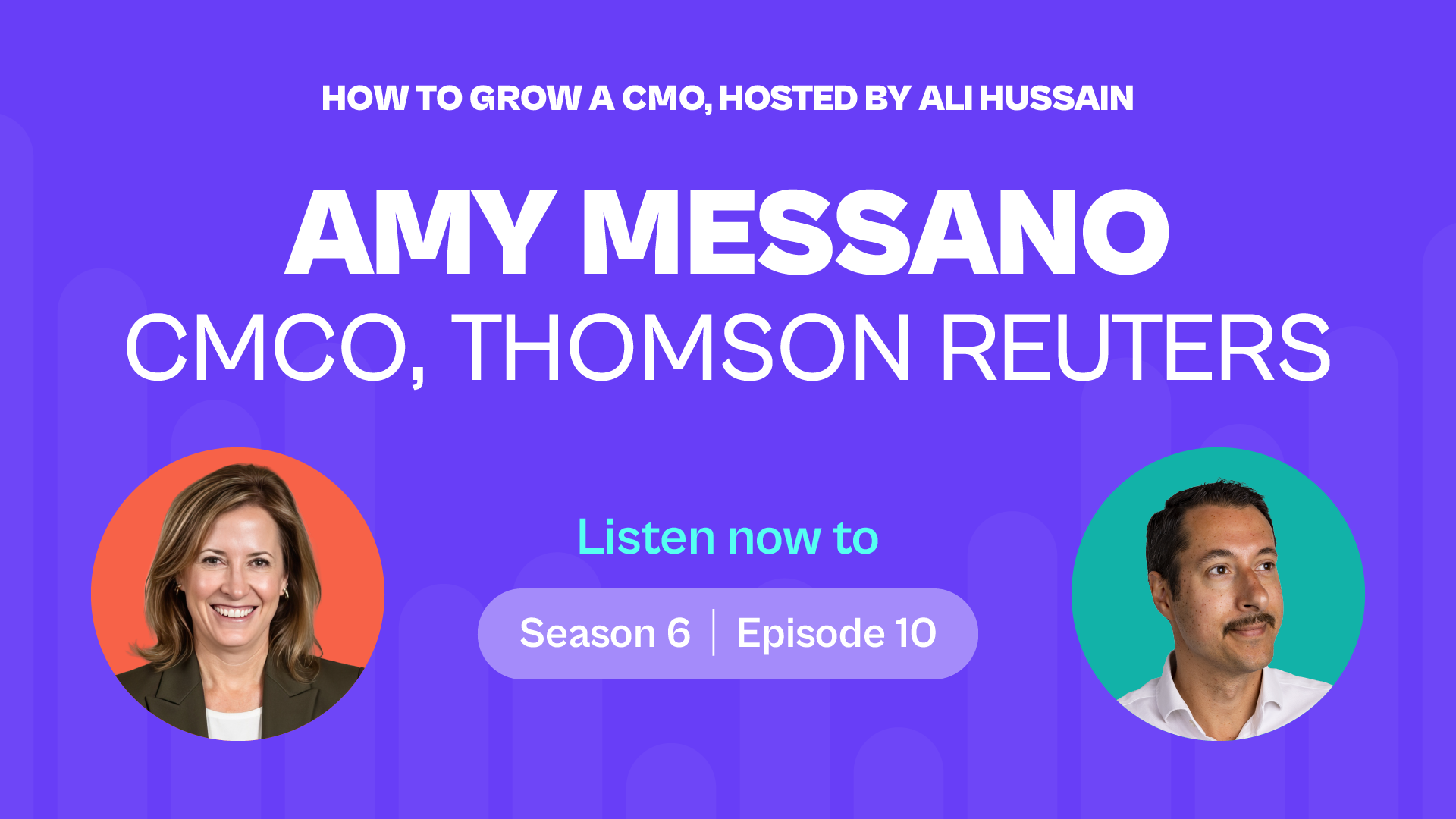
On this episode of How to Grow a CMO, host Alastair Hussain is joined by Michelle Cooper, CMO at NiCE.
Michelle reflects on growing up in a military family, moving between cities, schools and countries, and how that early exposure to change shaped her adaptability and confidence as a leader. She discusses the values instilled by her parents, the importance of trusting yourself earlier, and the moment an internship at Texas Instruments Software sparked her interest in the intersection of marketing and technology.
They also explore the evolving role of the CMO, from proving marketing’s business impact to building systems that can scale. Michelle shares why she sees marketing as a growth engine, how NiCE is using AI to transform customer experience, and why marketers need to stay closely connected to product, data and business outcomes.
-
Ali
Michelle, thank you so much for joining us today.
Michelle
Thank you so much for having me. It's great to be here.
Ali
Could you tell me a story from your childhood that's shaped who you are today?
Michelle
Yeah, absolutely. It's a great, great question to start with. So I was raised in a military family. So every couple of years we move to different cities, countries, you know, schools. And I learned pretty quickly that you could either be very anxious about that change or you could lean into it and really embrace it. So I think that really helped to shape me and how I think about new environments and change and uncertainty today.
Ali
Probably quite a useful skillset to have, I think, for anyone in 2026, I suspect, especially a CMO. So whereabouts did you get to move? Did you move around the country, move around the world?
Michelle
We did, yeah. We lived, I mean, anywhere there was a US Air Force base, Air Force base in the US and had the opportunity to go abroad actually and experience both Spain and Turkey. I was young, but it really was just a, it was a great opportunity. And again, just, you know, felt very, very fortunate to be able to experience those cultures and to live abroad so early.
Ali
So I have a couple of friends who also moved around for either similar reasons or, yeah, related reasons. And they've said it's always been interesting that actually then this idea of a sense of home, which other people associate with permanence or one particular place, they actually find it quite easy in some ways to pick up the idea of home and take it with them wherever they land. Is that something that you have, or is there other places around the world that you always think of as home?
Michelle
Yeah, for me, Virginia is really home. And I think, you know, largely because it was where later in life I was able to really establish a lot of roots, right? In community, in schools, with friends and family. So I think for me, it really, because I maybe didn't have as much of that, when I did get to build that in and build that for our family, it just really became home for me and kind of that grounding spot. That sense of community is very, very important.
Ali
No, I love that. I grew up in a relatively small village and somehow at the back of my head, although not consciously, I'd always imagined myself being back in, again, a relatively small community somewhere rather than a large city, which I also very much enjoy. But there was something in the back of my head that had formed quite early on this is where I probably want to, and that was fortunate. Is there something, I mean, I wonder if it's drawing too much stretch, but if there's a parallel between moving around presumably every 2, 3 years or however often it was, and the nature of work colleagues and work communities where either you're moving role, moving departments or moving businesses, people are coming in and out of the team. Do you find like there is something about how you manage relationships today with the somewhat transient colleagues that you have versus how you were as a Yeah, it's an interesting perspective.
Michelle
I've never really thought about it that way, but I would agree. I think from an adaptability perspective, right, you meet a lot of different people, you work with a lot of different people with different styles, different cultures, especially in a global organisation. I do think some of that adaptability and being able to connect with people in, you know, different circumstances and different parts and times in your life and in different, you know, work environments, I do think that's a strength that it was really cultivated probably very early on from that opportunity to move and to learn and adapt. I mean, really, I think it comes to being able to adapt in a lot of different environments.
Ali
That's great. I mean, I wonder if there's a slight sample bias, obviously on this show, I interview CMOs, so always people who have ended up being pretty successful, at least on one vector of life. And often what's really interesting is no matter the very, very different types of backgrounds and journeys that CMOs have had to who they are today, they have a skill and an ability to take the positives out of it And whether it was conscious at the time, an ability to learn lessons that have then served them well later in life. But can you tell me a little bit about what you were like then when you were young?
Michelle
Curious, lots of questions. I inherently wanted to understand how things worked. And I can remember helping my dad actually change the oil in the car and being fascinated with how that actually all happened. Where the parts went and how to do that. And I will say, you know, if I kind of think about that and bridge that to my professional world, like I think that curiosity, like really understanding how the marketing discipline works, what is performing in the work that we're doing, constantly kind of being curious, I think that definitely, I see the parallels between kind of that in an early stage and kind of how that in, kind of informed and shaped me, and then how I actually bring that into the work that I do today with the team.
Ali
And again, that's a real common theme that I find is that constant curiosity, and especially in the world that we live in today with so much changing, insatiable curiosity is certainly one of the first things that I look for in the people that I get to work with.
Michelle
Especially in this world with AI, and just think about how much change in the marketing function has come over the last— I used to say 2 to 3 years, and now I'll say 2 to 3 months. I mean, it is remarkable just how quickly this whole discipline discipline is continuing to evolve.
Ali
Yeah, absolutely. So thinking about the personal journey you've been on, have there been any particularly significant influences in your life that you think have had a big impact on it?
Michelle
Absolutely. I would, and it probably sounds cliché, but it really, I mean it, for me it is at my core. And I will say it really starts with my parents and what they really instilled in me is just a tremendous amount of pride in the work and the work ethic, and then grounding that in being humble, right, and grateful for every opportunity that this crazy world has afforded me. So it just, you know, it really has started, you know, as cliché as it sounds, you know, really feel very, very blessed, and they have really had such an instrumental impact in shaping who I am today.
Ali
That's amazing. I spoke to Erin from IBM the other day and she was saying the same thing, that actually, despite all the changes that have happened around her and the various different things that have happened in her life, those core values seem to have remained a real constant for her. And to have that centering, I think, you know, despite all the other things that might happen around us, having that kind of centred sense of self and core values, it's unbelievably valuable. Is it something, if you were to talk to your younger self, is that something you talk about? You know, to say, look, you know, hold on to these, these are gonna be incredibly important. Or is there other things that you want to say to them?
Michelle
I think holding on to those those core characteristics I think is really important in making sure that you're grounded just as a human and as a professional. I think if I were to go back and talk to my younger self, it would probably be more along the lines of trusting myself earlier, right? I had an opportunity to have some great mentors and people and role models that I worked earlier in my career with. And I always felt that in many ways, they trusted me sooner and earlier than I actually really trusted myself. And so I think if I could go back, I would've said I would've pushed myself a little bit harder to get out of my comfort zone faster and kind of lean in more in those places where you really maybe at the time didn't feel as comfortable, but knowing that those are the moments that you're actually growing the most in.
Ali
Where do you think your life might've been different if you had trusted yourself earlier? What do you think might've gone differently?
Michelle
You know what? I wouldn't do anything differently. Really, I mean, I really, no, if I look back on it, no, it just every opportunity, every experience kind of compounds. I fundamentally believe that everything happens for a reason and this is the journey.
Ali
Just to push you on that, were there ever any kind of any mistakes you made, anything you did and you're like, actually, if I did have the chance, I'd just say probably don't do that one or maybe take a swerve around whatever that might have been?
Michelle
Are there any mistakes you think, "Oh gosh, actually that was an interesting life choice there." I think maybe one life choice that was really like a very big kind of moment for me was early on, I worked at a company for a mentor and someone that I had worked for for years. And I had really both a professional and a personal relationship with them. And I kind of got to the point in this company where I realised that it wasn't the best place for me. It just wasn't the cultural fit that I was looking for. Maybe didn't afford me the growth opportunity. So I had to make a really tough decision to say, hey, is now the time to leave and run the potential risk of damaging that relationship? In the end, I ultimately decided that that was the right thing to do. But it was tough. I mean, it was a really tough decision to do that, but it really, it put my career on a completely different trajectory and was a very, very pivotal step into where I am today and the work that I'm doing. But I guess, I don't know that that's a, was it a mistake?
Michelle
But it was a very intentional kind of inflection point of, hey, you can stay on the path that you're on, and continue to be successful, or you can really make a tough decision and take yourself on a completely different path and journey at the time, which was a little unknown, but absolutely was the right decision personally, professionally, all of those combined.
Ali
Considering what you said earlier about being able to trust yourself and to push yourself into those uncomfortable situations, it sounds like that was certainly one of those moments where you probably realised that you had taken that leap in terms of self-belief, which is really lovely. What do you think other people would've said about you when you were a younger person, your friends and family? How do you think they would've described you?
Michelle
They would've said I had a plan.
Ali
Oh, really?
Michelle
I had a plan. I was on a mission. I knew I was going somewhere. I didn't know exactly where, probably candidly, but I was pretty focused. And one of the Kind of data points just to kind of bring that home. When I really figured out what I wanted to do, and it was like this intersection point of marketing and technology, like I was laser focused on who did I want to work with, you know, who did I want to work for, where, what kind of work did I want to do? And I was on a mission so much so that I often tell the story that before I actually walked for graduation, I had already worked 2 weeks in my first full-time marketing role. So I had started my career before I actually walked for graduation. That's how focused I was on, on like getting started, putting that plan into place and get going.
Ali
That's amazingly impressive. Actually, I don't meet many CMOs who feel like everything was planned out from an early stage. Often it feels like, you know, people have slightly fallen into the path that they now live and lead. If you hadn't gone into marketing with your plan, where else do you think you might have ended up? Did you have kind of previous plans to be an astronaut or a rock star or a farmer or anything like that?
Michelle
You'll laugh at this. One of the things I actually remember saying out loud as a kid, and I'll caveat that, was that I would want it to be like the first female president of the United States.
Ali
Oh, wow. That's all, I mean, that's a proper ambition.
Michelle
I was gonna say, obviously that did not come to fruition, nor did I ever pursue it, nor would I ever pursue it. But it definitely, I mean, it's maybe just a little bit of insight into like, you know, having a wild idea and being ambitious, right? Or having ambition in regards to what was possible.
Ali
I love that. Did you actually go into any kind of politics or were you interested in the politics side of things at all?
Michelle
No.
Ali
No.
Michelle
No, never pursued it.
Ali
Managed to dodge that one. Oh, thank goodness. Very good. Is there anything else that you think, you know, when you look back on the things that have made you the person you are today, is there anything else that you think, wow, I was lucky that happened, or I was lucky to have met this person or to have read that book or to have been to this event? That you always remember as one of those kind of strange memories that bubbles up from time to time and you think, actually, that, yeah, that really did shape me in some way?
Michelle
Absolutely. I was interning actually. My first, I'll call it real internship, was at Texas Instruments Software. And I was an intern, as green as they come, sitting around waiting for someone to tap me on the shoulder to get engaged and do something. But I got pulled into, at the time, a product launch. So the company was launching a new capability and I got pulled into that and I loved it. It was like the first kind of, I'll call it true exposure that I had to marketing. And it was like watching the whole thing come together. And I remember like the energy, I can picture the day, I can tell you kind of exactly where I was at. Actually, I can tell you what I was wearing the moment that I was like, oh my gosh, this is, I know this is what, I want to do. And very quickly when I went back to college, I did two things, right? I declared my major as marketing, and I also added a second degree on MIS, right? Which at the time, if you go back, I won't date myself, was pretty progressive at the time to put those two disciplines together.
Michelle
But I remember just like in that moment knowing that I love the aspect of the marketing, And I wanted to do it in the technology space. And that, you know, again, I just kind of a special moment. Again, up until that point, I didn't know. I knew I was a business major, but I didn't know if I was going to specialise in any one area. And I really hadn't leaned into the technology piece of it. But it really, I mean, it set the stage for me, both as a functional discipline, but then actually doing that in technology companies throughout my career at all different sizes and shapes and levels of maturity.
Ali
What was it about that combination of marketing technology? So as an example, so if I look back on my childhood, I realised I was a total geek, happily a total geek. I had a Spectrum ZX, did a bit of coding, loved anything geeky to do with tech and computers. I'm sure I got some of that from my dad who worked for HP and all sorts of things. So HP as it was back then. What was it about that combination of marketing and technology that you found so interesting?
Michelle
Yeah, it's a great question. I like the being able to take the technology and figure out how to distil that down into problems that you were trying to solve. Like, you know, how do you take something that's very complex and be able to translate that into problems? I remember early on, I prided myself that I actually could demo the products, right? Like that I could, actually demo the solutions and be able to talk to the customers, our customers at the time and the prospects. So it just, I don't know, it just, it resonated with me to be able to take something that had so much potential from a capability perspective and then marry that with the discipline of marketing of how do you distil that down into, you know, problems that you're helping organisations solve and make that as simple and as consumable you know, absolutely is possible. Chaos in B2B marketing is not just frustrating, it's expensive. TMP's latest research shows it could be costing organisations up to 15% of potential revenue and extending sales cycles by 30%. Want to see what chaos is really costing your team? Visit tmpb2b.com/cost-of-chaos.
Ali
One of the things that you talked about was products and how interested you were in being able to operate the products and demo the products. So could you tell me a little bit about those early days of marketing where, you know, I think you said a product launch was what got you really interested in it. What was it like? What kind of roles were you doing there?
Michelle
What were the kind of companies you were working From the time that I started in, in marketing until now, I have always worked in B2B technology companies, right? Midsize companies, some of the world's largest software companies, and across a lot of different technologies, applications, to development tools. And, and that's one of the things that I really have enjoyed is just that, that variety and, and being able to understand how all those different technology components come together. And obviously most recently, you know, AI and the work that we're doing today, both in marketing as a function, but also here at NICE. Over that time in my career, like, I really kind of tried to work in every facet of marketing that I could get exposure to. Field, brand, industry marketing, product marketing, you know, just to really kind of understand those different disciplines And then, you know, ultimately, you know, how do you put them all together? And I, you know, whether that was going very deep in field and understanding demand generation, or working with brand experiences at SAP, again, each of those, you know, just all, you know, provided different learning environments and opportunities to, you know, understand those, those functional domains a little bit deeper, and then to put them ultimately all together now in the work that I do here at NICE.
Ali
And of those various areas you mentioned, were there some that you found much easier to pick up and found you were very naturally talented at and good at, and others that were more tricky?
Michelle
I'm very data-driven, so being able to really look at demand performance impact, being able, you know, a lot of times I was saying probably more operationally oriented CMO and being able to connect the business outcomes with the marketing outcomes. You know, I think for me, that is where I gravitate to and comes more naturally. And I learned, I had an opportunity to learn from some of the best along the way to be able to really understand how you look at the impact of marketing and monetize it and communicate that, you know, from a business impact perspective. And I will say that one of the things that I've always kind of prided myself on is that, like, I understand the business. My understanding of the business and business acumen first and my marketing expertise second. And I think that's a really, you know, in the world that we live today, you know, and the scope of the, different areas that marketing plays in so many organisations, you really have to be able to wear both of those hats and naturally jump back and forth in between those two worlds.
Ali
Yeah, I'd echo that and agree with that entirely, the idea of marketing that closely aligns to the business. Interestingly, a couple of things that I'd love to pick up on. One is you talked about your love, your facility with building systems. Now, I think there are many, many ways to approach any given challenge, and I think there are many different types of CMOs who can do extremely well in many, many different situations. So I didn't subscribe to this idea that there is an ideal CMO archetype, if you like, you know, you're looking for a particular blend and particular balance of skills for every single CMO role out there at any time there is. I don't subscribe to that at all. Having said that, I think this systems building CMO does seem to be a CMO that is definitely highly in demand at the moment. And we've even seen it then philtre through into other marketing roles, the idea of a go-to-market engineer and some of those slightly more recently developed titles. I just think that's very interesting that, you know, that systems building, systems thinking approach is something you probably bring to your CMO role today.
Michelle
Absolutely. And yet you have to, I mean, 'cause you know, you're driving growth for the business. I mean, you are a growth engine. Marketing is a growth engine, at least that's my philosophy. If you don't start there, you can get consumed and distracted very, very easily. Easily, but you're also architecting your own transformation, right? I mean, just think about marketing and the, the adoption of AI and the pace of which marketing— so if you're not thinking about people and processes and the technology that you're going to need to, to be able to scale as a marketing organisation, you're gonna find very quickly that the, the market and the capabilities will outpace the capabilities that you have within your, your team and, and your own organisation.
Ali
Absolutely. And is there any advice you have for other marketing leaders who are looking to prove the impact of marketing in a compelling way, you know, presumably managing upwards either to their own CMOs or to the board and CEO?
Michelle
Listen, I think this is always a work in progress, and I'm not going to claim that I have the playbook fully figured out, but I think if you really ground in what are the business objectives, what are the growth objectives, and then the investments that you're making, the programmes that you're driving, the shifts that every one of those anchors back to those pillars, and then you're able to wrap that with data and proof points and demonstrate where you're making progress. I think it is, it's really a combination of those things. And I will say, I think depending on, you know, the organisation, the maturity, you know, you're, you're constantly evolve— evolving that playbook based on where you're at, what you're trying to accomplish, and also the executive team around you and what they're really looking for marketing to fulfil and deliver on.
Ali
Yeah, absolutely. And you've had the opportunity to work with some fantastic businesses, obviously, where you currently are, NICE, an incredible business to be at, and also SAP prior to that, you know, another really legendary software company. Tell me a little bit more about NICE and the role of marketing there.
Michelle
Absolutely. So I don't know how much you know about NICE, but we are a global leader in AI customer-powered experiences. So we're helping the world's marquee brands support and serve their customers through leveraging AI to automate their customer journeys the whole way through from intent to resolution. And we are a recognised leader in doing that at scale and growing very, very quickly. From a marketing perspective, I mean, NICE, we are at the centre of the transformation of our company. We're going through a massive overall transformation at a company level. We're going through a massive transformation from a marketing perspective. And we are in the centre of really driving that. I mean, it's not just from a how do we shape and tell the story, but it's actually how do we define the market category of what CX AI means and making sure that we're really recognised as a leader. And in a space right now and in a market where there's a lot of noise, and I think just noise and disruption around, you know, AI, what does it mean? How do you use it? Where to bring it? You know, how does it change your operating model and how should you be thinking about transforming your, your own business?
Michelle
I think marketing plays a significant role in being able to drive that clarity and message and help our customers understand the problems that our solution set and AI capabilities actually help them solve for.
Ali
So, I'd love to talk a little bit more about that role in the external positioning as a category that's undergoing a significant shift. But actually, I also want to just pick up on something there you mentioned around marketing leading some of the internal transformations. So, again, that's a theme that I've heard quite recently in quite a few conversations with different CMOs. In fact, I was speaking to Megan at Samsara just yesterday. And we were talking about this, and there does seem to be a pattern there. You know, I've got to think enough data points now to suggest that there is a pattern, that marketing does not have a role of leading internal AI transformation and showing what can be done, how to go about it. Is that something you've seen not just in NICE, but you kind of hear elsewhere as well? Or interesting perhaps, are there other parts of the organisation as well that you think are also really on the front foot with this?
Michelle
Yeah, and listen, I think there's, there's so many use cases right now in marketing from an AI perspective, but I think it's actually like 50% of the use cases sit within marketing. So I think it's a, it's a tremendous opportunity for us to really lead and consume the same technologies that we're talking with our customers about. So that's one of the things that we've actually done is we've built an AI roadmap. We're completely rethinking the roles and skills that we need within our organisation. We've invested in tooling and enablement to make sure that our marketers are really well equipped. And we're also using our own technology to actually interact with our own customers, right? So one of the areas that we lead in is, is in conversational AI. So we're actually in the process of rolling out an AI agent on our dot-com and our digital properties that will— be able to interact with our customers and prospects and investors. And so really taking the technology that, that we bring to our customers, embodying it, and then using it to actually improve our own customer experiences and journeys. So, yeah, we're consuming it in so many, so many different ways.
Michelle
And there's just a tremendous amount of opportunity for us to lead across the entire organisation.
Ali
Interesting. That also speaks a little bit to the blurring of boundaries, talked about the kind of the blurring of the internal, external there. You are using the software that you are talking to the world about. There is the nature of your software, obviously, that does sit at that intersection of the internal organisation, the customers, and the ecosystem. So I think that is very interesting. One other thing you mentioned in the previous episode that I wanted to dig a little deeper into is this idea of product. So we recently did some research around what's causing chaos in marketing. And one of the areas we asked around was a sense of silos and what you feel disconnected from as a marketer, different parts of marketing or different parts of the organisation. And actually the part of marketing that most people said they felt most disconnected from was actually product, which I thought was really interesting. So I'm quite an old-fashioned marketer. I think of the 4 Ps of marketing in terms of the levers available for those kinds of tactical levers. You obviously said that you grew up being able to demo the products that you were selling.
Ali
First of all, do you see a potential challenge and a potential problem for marketers here where we maybe have drifted away from the product function in some cases? And second, if you do, do you see any ways to remedy that or anything you've done to remedy it?
Michelle
I think you have to be connected with the product. If you don't understand the roadmap, the direction, how the buyer needs come together with the capabilities and the innovation roadmap, I think you're, you're really missing an opportunity. At NICE, we have a very, very strong product marketing organisation where we actually sit at the table with our product and engineering colleagues and not only have a point of view on how do we launch and bring the products that they're developing to market, but also where the market is, is going. And I think that one of the things in our operating model that I am extremely proud of is that we have marketing like integrated end to end in a truly unified fashion. Product, comms, influencers, you know, marketing competitive, the whole way through demand and field and partner enablement. So we're able to really help bring that full lifecycle to bear, you know, whether that's through increasing market visibility or building demand, but we're able to do that end-to-end. And some of the organisations, it's neither right or wrong, but I've seen different operating models over time where it can be very fragmented. So you miss those opportunities to connect the product, right, with the campaigns and the messaging, right?
Michelle
Or you miss launch moments because you don't have that connected with your influencer and your comms function. So I think that's one of the things that that really is a strength of ours here at NICE and I think is a best practise to be able to put that functional alignment end to end the whole way through how our sellers and partners carry that message and are equipped to carry that message into market.
Ali
Yeah, I love that. And one of the things that I talk about a lot with clients is the importance of coherence throughout the function. So this idea that there is an internal coherence that then shows up externally to the world as an external coherence. So yes, guess what? The product is coherent with the things that you are saying about the product and the way that people are selling the product and the parts of the market you're going after in order to sell that product. So I think that what you said there is absolutely critical and still one of the biggest challenges I think that most CMOs face. How do you bring coherence to what is innately often an environment where things are being pulled apart? So I think that's brilliant. One other question as well, that obviously you did, you worked at SAP for quite a while, such a very big, very interesting business. Are there lessons that you've taken from SAP that you think are applicable elsewhere?
Michelle
Absolutely. Amazing journey at SAP. I mean, so much opportunity, work with great leaders. I think for me, one of the things that I really took from them is how do you scale globally, right? You know, how do you support, you know, a $35 billion business across every region, country? And so, So for me, that's one of the things, like I think about the work that I'm doing now at NICE is like, how do we scale and grow, you know, in an exponential way? And that definitely learnings from SAP. The other thing I will say too is the persona component. You know, one of the things that I really liked about the SAP work is that you worked across every virtual persona, the HR line of business. Supply chain, manufacturing to IT. And I think having had the opportunity to work across all of those different buyers and understand how they think about problems and business processes and being able to really bring that down into like the business outcomes and the value that those solutions provide, like that, that value orientation and outcome orientation. outcome. Like that was something that was just instilled in everything you did, whether that was through a line of business or through an industry.
Michelle
And again, I think that work and learnings that I take with me into my new opportunity.
Ali
It's lovely, isn't it? It's kind of one of the forms of expression of customer centricity, isn't it? That deep, deep understanding of the personas. Very, very interesting. And you mentioned obviously that scale is one of the exciting challenges you're taking on at NICE. Is that the biggest challenge for you right now if you look at the next kind of 2, 3 years? What is the one big marketing challenge that you'd love to solve?
Michelle
Absolutely. I mean, I'll answer that in kind of a couple of ways. The first one is making sure that the market really knows who NICE is and the leadership position that we have. I mean, whether it is in the conversational AI leader, like we are the leader, we just actually recognised last week by Forrester as the outright leader in that aspect. And we also are a leader in our core CCaaS offerings. So I think just increasing the visibility and the understanding of the capability and leadership that we have in this market category and the work and the innovation that we have available today to our customers and making sure that the market understands that, our customers understand that, and our partner ecosystem system. Like, for me, that's number one, to make sure we really help in that company transformation to lean into AI and the role that we play in shaping the future of customer experience and, you know, in an AI-powered environment and world. So, that's number one for me. The second thing I would say is I think in any organisation, you're kind of going back and forth between the short-term Right? What do you need right now to feed the, the growth?
Michelle
And then how are you actually balancing that with building the capabilities that you're going to need to, to really sustain that growth, right? So that, for me, it is making sure that our leadership team and our board understands the importance of brand and demand, and that those will, will ultimately sustain our growth and grow faster if we're making both of those investments, not one at a trade-off for the other. And then building the foundation that we are going to need to be able to scale globally in a more consistent way. So it's kind of that tension of getting our brand out in the market, making sure that everyone understands the leadership— the clear leadership position that that we have while I'm also building the programmes and the marketing elements that we need for to fuel our short-term growth, but also making sure that we are positioned to grow and compete effectively as more and more market players come into this space.
Ali
Amazing. Thanks, Michelle. Thanks, Jane. That sounds like you've got quite a lot on your plate then for the next few years. Moving more to your kind of influences and who's shaped you as a marketer, do you have any marketing heroes? People you've worked with or people you've read or kind of some of the bigger voices in the field?
Michelle
I do. I feel very fortunate to have worked with some of the best actually. And there are two people I would put at the absolute top of that list. The first is Alicia Tillman. I don't know if you know Alicia. I'm sure you're very familiar with her, but could not work with a better marketing executive or someone that really is able to shape the clarity and scale a global brand. So I would put her in my hero list. And then most recently, when I was at SAP, I had the opportunity to work for Julia White. And Julia is, you know, just an exceptional strategist and storyteller and really being able to, you know, take the product capabilities and really distil that down into a very, very business value-oriented message. So I just, again, And I've learned so much from both of them, and they are my heroes, both of them.
Ali
And how have they— you've talked about some of the ways you think about marketing in terms of the importance of its connection to the business, the importance of its integration, understanding of the product and then the customer. Do you have any other guiding principles as a marketer that you keep going back to?
Michelle
Customer first, always. Data-driven, outcome-focused versus activity-based, and really wear your business hat. First and foremost, always.
Ali
Brilliant. Thank you. Well, thank you, Michelle. I'd love to just ask you a quickfire round, if that's okay. So hard questions, but enforced short answers, if that's okay. So the first is to complete this sentence, the qualities I look for in my next exceptional hire are—
Michelle
Curiosity, collaboration, confidence to challenge the status quo.
Ali
I love that. Thank you. I think curiosity might be the number one. Most cited quality, which I love. I often say that the only problems that worry me are the ones I can't see. So I try to be open with my team about any challenges I have, mistakes that I make, so that I create a space where they're comfortable doing the same. In the spirit of that, could you share a mistake that you've made in the past few weeks?
Michelle
Oh, they're probably endless. There's probably a situation where I wish I had moved faster, right? Like I knew it was there, I knew it needed to be addressed, but we moved down the list versus staying at the top. So I think kind of just that relentless focus on prioritisation and knowing that those things do not go away. Like, so I just think moving, moving faster. would probably be my learning.
Ali
I love that. I think that's a great thing to share. Thank you. What's something that most people get wrong about you?
Michelle
I think sometimes people confuse kindness with being very, very intentional and very, very relentless on being able to make hard decisions and ultimately focus on the business outcome.
Ali
I love that. Thank you. And then penultimately, what are the 3 technologies you're most excited about over the next 10 years?
Michelle
Can I just say AI 3 times?
Ali
You can. You also wouldn't be the first. AI, AI, AI. And it's hard to argue.
Michelle
I just, I wrote this great article just recently and it was talking about how the marketing organisation will look completely different, the roles, the setup, the skills. And I just, I think that right now we cannot lean into that hard enough as marketers, as leaders to really make sure that we're thinking progressively enough about what the future will really look like because if we don't start understanding that now to be able to catch up 6 months, 9 months, 12 months down the road, we will— you will be at such a deficit that I think you do a huge detriment to the organisation. organisations that we lead and support if you're not already thinking about how do you leapfrog where we're at from today.
Ali
I agree. I think it's probably one of the questions that I get asked the most from CMOs at the moment is, you know, what does the marketing function of the future look like? So yeah, I'd love to talk to you more about that. And then finally, what's one piece of advice or one idea either about marketing or about life in general that you keep coming back to?
Michelle
For me, it's this belief that I can inherently always get better. I believe that professionally, personally, in the teams that I lead, like, it's just an innate, inherent kind of belief that you can always learn, get better, and just in a really, you know, kind of embrace leaning into that. And I do. I believe that inherently at my core. And I think the teams that I have the, you know, opportunity to work with We, you know, see that, you know, hopefully and experience that every day.
Ali
Brilliant. What a lovely kind of invigorating and optimistic note to end on. So Michelle, thank you so much for being with us today.
Michelle
Thank you. It's been wonderful.